
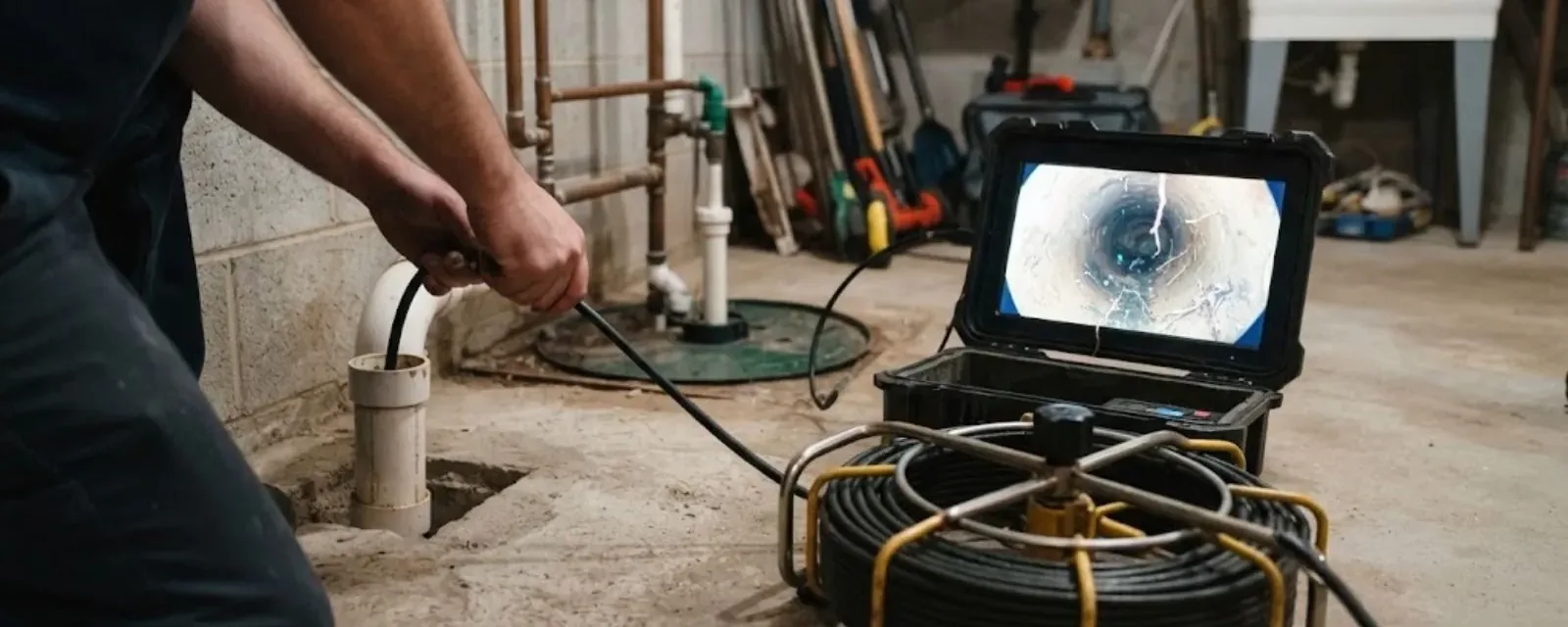
A sewer line is buried, so most problems stay invisible until water stops going down. A sewer camera inspection removes the guesswork by sending a small waterproof camera through the pipe while a plumber watches the screen.
It is a planned visit rather than an emergency one, though the phone is answered 24/7 if you want to book at an odd hour. Sewage coming up in the house is a different situation, and that belongs with our sewer line repair team.
What the camera actually shows
The camera travels from a cleanout or a pulled fixture toward the street. On the screen the plumber can see the pipe wall, the joints and anything sitting in the bottom of the line.
Typical findings include these:
- Roots pushing into a joint or growing as a mat inside the pipe.
- Cracks, breaks or a joint that has slipped out of line.
- A belly, which is a low section that holds water and waste.
- Grease, scale or debris coating the pipe wall.
- A collapsed or crushed section where the camera cannot pass.
- Where the pipe changes material or direction.
A camera shows condition, and it does not replace judgment. A plumber reads the footage, explains what is serious and what is cosmetic, and tells you if the pipe needs more work.
Inspecting before you buy a house
A home inspector usually looks at fixtures, not at the buried line. If you are under contract on a house, a camera look at the sewer line can show whether the seller is leaving you a root problem or a failing section. Ask your agent how your inspection window works, because timelines vary.
Be realistic about the limits. The camera can only see the part of the line it reaches, and a bad finding is something to take back to the seller or your agent, not something we negotiate for you. If it turns up damage, our repair team can explain what the fix would involve before you commit.
When repeat clogs call for a camera
One clog is an event. The same drain clogging every few months is a pattern, and a pattern usually has a cause that cabling will not fix. Roots, a belly or a broken joint can all produce the same slow drain, and they need different answers.
That is the moment to look inside. A camera visit after drain cleaning can show why the line keeps coming back, and it often saves money by pointing at the real problem instead of the symptom. If the footage shows heavy buildup, hydro jetting may be a better next step than another round of cabling.
Reasons to schedule a camera visit
Repeat backups
The same drain or main line clogs again after being cleared, and you want to know why.
Buying a house
You want to know the condition of the line before you close.
Before landscaping or digging
You plan trees, a patio or a trench, and want to know where the line is and how it is doing.
After a repair
You want to confirm the work cleared the problem and the line is open.
Odd smells or gurgling
Drains gurgle or the yard smells, and the cause is not obvious.
What the visit looks like
Call and describe
Tell dispatch about the clogs, smells or purchase so the plumber arrives with the right gear.
Find access
The plumber locates a cleanout or pulls a fixture to reach the line.
Run the camera
The camera goes through the pipe while the plumber watches the screen and notes problem spots.
Review the findings
The plumber explains what the footage shows and what the options are.
If the line is blocked, it may need clearing before the camera can pass. That is normal, and sewer line cleaning handles it. We tell you before any extra work begins.
Want the line checked?
Call to book a camera visit and tell dispatch what you are seeing.
Camera inspection compared with other options
| Approach | What you learn | What it misses |
|---|---|---|
| Camera inspection | The real condition of the pipe from the inside | Anything past a blockage the camera cannot pass |
| Cabling the line | Whether a clog can be cleared | The cause of the clog and the pipe condition |
| Digging a test hole | Pipe condition at one spot | Everything else along the run |
| Waiting for the next backup | Only that something failed | When it will fail and where |
Kuna lines, new and not so new
Kuna went from 15,210 residents in 2010 to 24,011 in 2020, which means plenty of local houses sit on relatively young lines. Young does not mean trouble free, because poor joints, settled trenches and root growth from new landscaping can all affect a newer pipe. A camera visit is useful on a house of any age, and it is the quickest way to tell a clean line from a hidden problem.
Before the plumber arrives
Find your cleanout if you know where it is and clear the area around it. Do not pour drain cleaner into a slow line, since the chemical sits in the pipe where the camera and the plumber have to work. Note which fixtures are slow and when the last backup happened, because that helps the plumber choose where to look.
What a sewer camera inspection costs
Camera visits for Nampa and nearby towns
The same camera work is available across the Treasure Valley. The Nampa plumber page explains how we cover that side, and our service area page lists the other towns we serve. If you are shopping around for a pre-purchase look, tell dispatch which town the house is in so the visit can be planned.
Sewer lines in Idaho are installed under the 2017 Idaho State Plumbing Code, based on the 2015 UPC, so the video shows whether the line matches the slope and joints that code expects.
Sewer camera inspection questions from Kuna homeowners
Yes. The phone is answered 24/7, so you can call any time to book. Planned camera visits are scheduled when the plumber's schedule allows, and urgent backups are handled as emergencies.
It shows the condition of the pipe, and a plumber explains what the footage means. Cracks, roots, sags and collapsed sections each lead to different options, from cleaning to lining to replacement.
It is worth considering, especially on a house you know little about. Ask your agent how your inspection window works, and call to plan a camera visit that fits it.
If the same drain has slowed more than once a year, or cabling only helps for a few weeks, a camera can show why. It beats paying for another clearing without knowing the cause.
It can show where the camera stops and what the pipe looks like at that point. A fully collapsed section may block the camera, and the plumber will tell you what else is needed.
Any repair that follows may need one, since the City of Kuna permit application lists sewer lines as covered work. Ask the Kuna Building Department at (208) 922-5546 about your situation before you start digging.