
A leak you cannot see is still an emergency when the meter will not stop or a ceiling is already sagging. Kuna Express Plumbing answers the line 24/7 for leak detection in Kuna, ID, including nights and weekends.
While you wait, close the main water valve if water is actively coming through a ceiling or floor, and move belongings out from under the stain. Tell dispatch where the water shows up, what the meter is doing and whether anything is running.
The meter keeps moving with every fixture off
This is the most common way a hidden leak announces itself. The test takes about ten minutes and tells a plumber a great deal before anyone arrives.
- Turn off every faucet, the dishwasher, the washer, the ice maker and any irrigation timer you control.
- Look at the meter. Many meters have a small dial or triangle that spins when even a trickle passes through.
- If it moves, close the main valve inside the house and look again.
- If the meter stops, the leak is inside the house. If it keeps moving, the leak is in the buried line between the meter and your main valve.
If a utility notice or an app alert is what first tipped you off, you can also call the City of Kuna water emergency line at (208) 573-7676. The Water Department says its staff are on call 24/7 for water and irrigation emergencies, and they can confirm what the meter shows on their end.
The water bill jumped but nothing looks wet
A bill that doubles or triples with no stain anywhere is a classic sign of a loss you cannot see. The usual suspects are a toilet that refills on its own, a stuck irrigation valve, a pinhole in a buried pipe or a slow leak inside a wall. Drop a little food coloring in each toilet tank and wait without flushing. If color shows up in the bowl, the flapper is leaking and the repair is simple.
If the toilets pass and the meter test points inside, a plumber checks supply lines, the water heater connections and the pipes behind the walls. If the meter test points outside, the work moves to the yard and our water line repair page explains what follows.
How a plumber narrows down where the water goes
| What you notice | Where the leak probably is | How it gets narrowed |
|---|---|---|
| Meter moves, main valve closed inside | The buried line from meter to house | Pressure test on the line, then listening gear along the route |
| Meter stops when main valve closes | A pipe, fitting or fixture inside the house | Isolate zones, check fixtures, then listen and read moisture |
| Stain or drip on a ceiling | A supply or drain line above it, or the roof | Trace upward, test the pipes, rule the roof in or out |
| Warm or damp patch on a floor | A hot line under the slab | Thermal and listening checks, then a plan for access |
| Soggy yard patch with no rain or watering | A buried supply line or an irrigation line | Shut off, pressure test, mark the stretch |
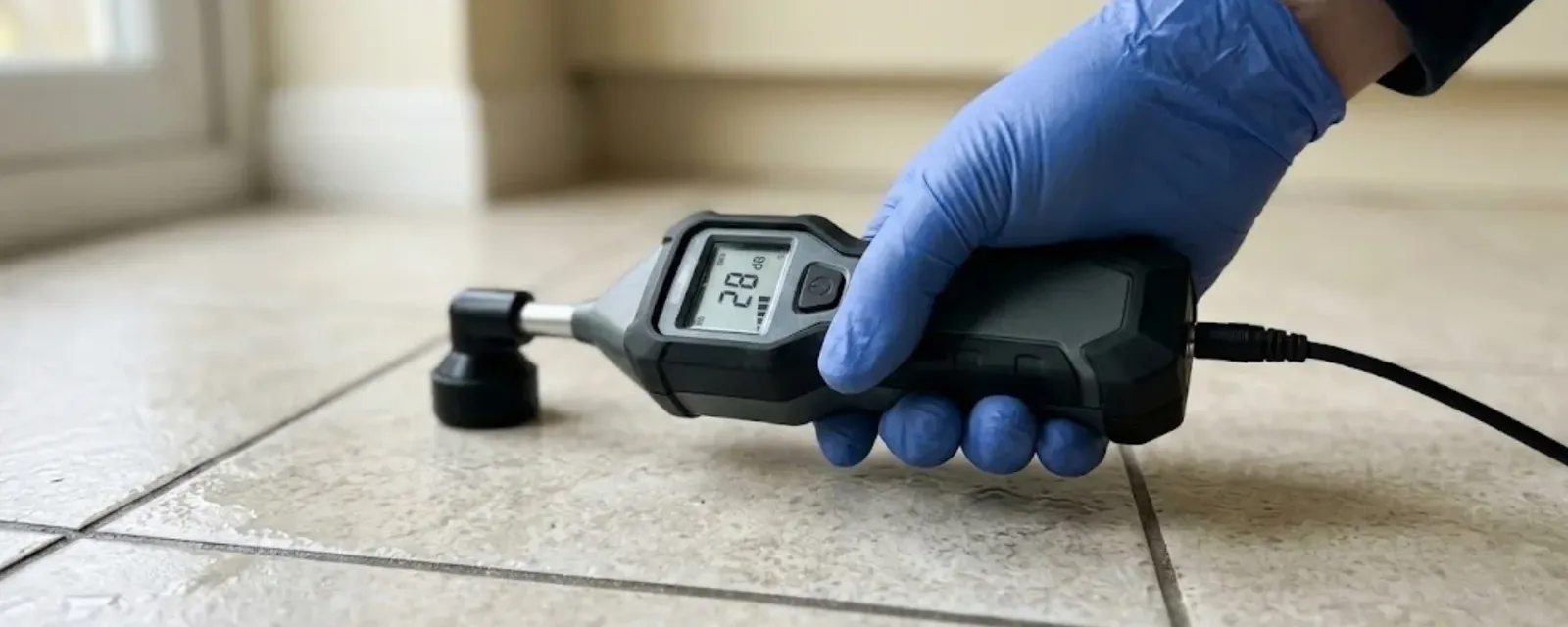
The tool depends on the pipe material, the depth and what is above it, and the plumber should tell you which method is being used and why. Deep or plastic lines are harder to hear than metal ones. We mark the spot at the surface when we can and say so honestly when the result is a stretch of pipe instead of a single point.
Dripping ceiling or a damp wall
Start by turning off the water at the main valve and see whether the drip slows within a few minutes. If it does, the source is a pressurized supply line. If it keeps dripping for hours, the source may be a drain, a shower pan, an air conditioning condensate line or the roof.
A plumber looks at the room above, tests the supply and drain lines, and opens only the section of drywall that is needed. Patching and painting are normally finished by a drywall or paint trade afterward, so plan for that step. If the wall is cold, wet and the pressure at your faucets has dropped as well, say so when you call.
Crawlspace and under-floor leaks
Running water you can hear under the floor, a drain that sags, or a sewer smell in one room point to trouble below the house. Do not crawl into a space that has standing water near wiring or a strong sewer odor, because those conditions are unsafe to enter without help. Turn off the main valve and wait for the plumber.
Once someone is under there, the job is to separate supply leaks from drain leaks, since they look alike when everything is wet. Supply leaks drip under pressure and stop when the main is closed. Drain leaks only show up when water is sent down the pipe. Pipes that froze and split show up here as well, which we cover on our burst pipe repair page.
Meter spinning or ceiling dripping?
Call the 24/7 line and tell dispatch where the water is showing up.
Slab leaks: warm floors, damp concrete and the sound of running water
Water under a concrete slab announces itself in a few ways. You may notice a warm patch on the floor, a damp edge near the garage, a musty smell, the faint sound of water when the house is quiet or a bill that climbs for no clear reason. Hot lines leak more often into warm spots, and callers describe a pipe from the water heater as a common suspect.
Finding the leak comes first. Once it is located there are two paths: open the slab and repair that section, or abandon the line and run a new one overhead or through the walls.
Rerouting makes more sense when the same line has failed before, and our repiping page covers that decision. A long slab leak can wash soil out from under a floor, so if you see new cracks or a floor that has shifted, ask a structural professional to look as well. We cannot judge a foundation from the pipe side.
Buried lines under the yard or driveway
A buried leak often shows up as a soggy patch in dry weather, a bubbling spot in the soil, low pressure at the house or a meter that never rests. Digging at random is how a small leak turns into a damaged yard. Before any digging, call Dig Line at (208) 342-1585 so buried utilities get marked.
The honest answer to "can you find it without trenching the whole yard" is usually yes, narrowed to a stretch, with the dig kept as short as possible. Some owners prefer to do the digging themselves once the spot is marked, and others want us to repair what we find. Either choice is fine, and you can tell dispatch which one you want.
Irrigation and sprinkler supply lines
The City of Kuna says its pressurized irrigation season generally begins in mid-to-late April and depends on when the irrigation districts deliver water. A leak in the supply line shows up as a wet spot, a weak spray or a valve that runs too long. The city also notes that low pressure is common early in the morning, so test again at midday before you decide the system has a leak.
We trace leaks on the plumbing side, meaning supply lines and valves that feed the system. Sprinkler heads and timers are normally a landscaper's job. If a backflow report is the reason your water was locked off, the city says backflow reports go to the Water Department, so call them about getting it reopened.
Pool, spa and hot tub water loss
A pool that drops faster than evaporation explains can be losing water from the shell, the liner or the plumbing. A simple bucket test, with the pool and bucket water marked side by side, helps separate evaporation from a true loss. We look at the supply, return and fill plumbing, and a pool contractor handles cracks in the shell itself.
What you can do while you wait
Safe steps while you wait
Close the main water valve if water is moving through a ceiling, floor or wall. Switch off power to a wet area only if you can reach the panel without stepping in water, and stay out of rooms where water is near outlets. Move furniture and rugs out of the way and catch drips with buckets. Take photos of any stain, because photos help the plumber and your insurance company.
If you smell gas at any point, leave the building and call 911 and Intermountain Gas before you call us. Never open a wall around a pipe you cannot identify.
What leak detection costs
Leak detection near Kuna and in Nampa
We cover the Ada County side and across the line in Canyon County. The Nampa emergency plumber page explains how dispatch handles addresses there. Nampa Waterworks publishes a 24-hour leak hotline at (208) 468-5860 for the pressurized irrigation it operates, so a Nampa homeowner with a wet yard should check which system the water is from.
A repair found by leak detection is made to the 2017 Idaho State Plumbing Code, based on the 2015 UPC, and a permit may apply, so ask the Kuna Building Department before large work.
Leak detection questions from Kuna homeowners
Yes. The line is answered 24/7, including weekends and holidays. Tell dispatch where the water appears and what the meter is doing, and close the main valve if water is moving through a ceiling or floor.
Turn everything off and watch the meter. If it moves, close the main valve inside the house and check again. A meter that stops means the leak is inside, and one that keeps moving means the buried line.
Yes. An alert or notice from the utility is a good reason to call, even if nothing looks wet. Say what the notice told you and the plumber will start with the meter test.
No. Finding the leak and fixing it are quoted separately, so you know the cause before you decide on the repair. Some owners fix it themselves once the location is marked.
Usually the leak can be narrowed to a stretch of pipe before anyone breaks the slab. Deep leaks or plastic lines can need more than one method, and the plumber will say if the result is a stretch instead of a spot.
A plumber tests the supply and drain lines above the stain and rules them in or out. If the pipes pass, the roof is the next place to look and a roofer is the right call.
Accuracy depends on the pipe material, how deep it runs and what covers it. We mark what we find on the surface and tell you how confident the plumber is in that mark.