
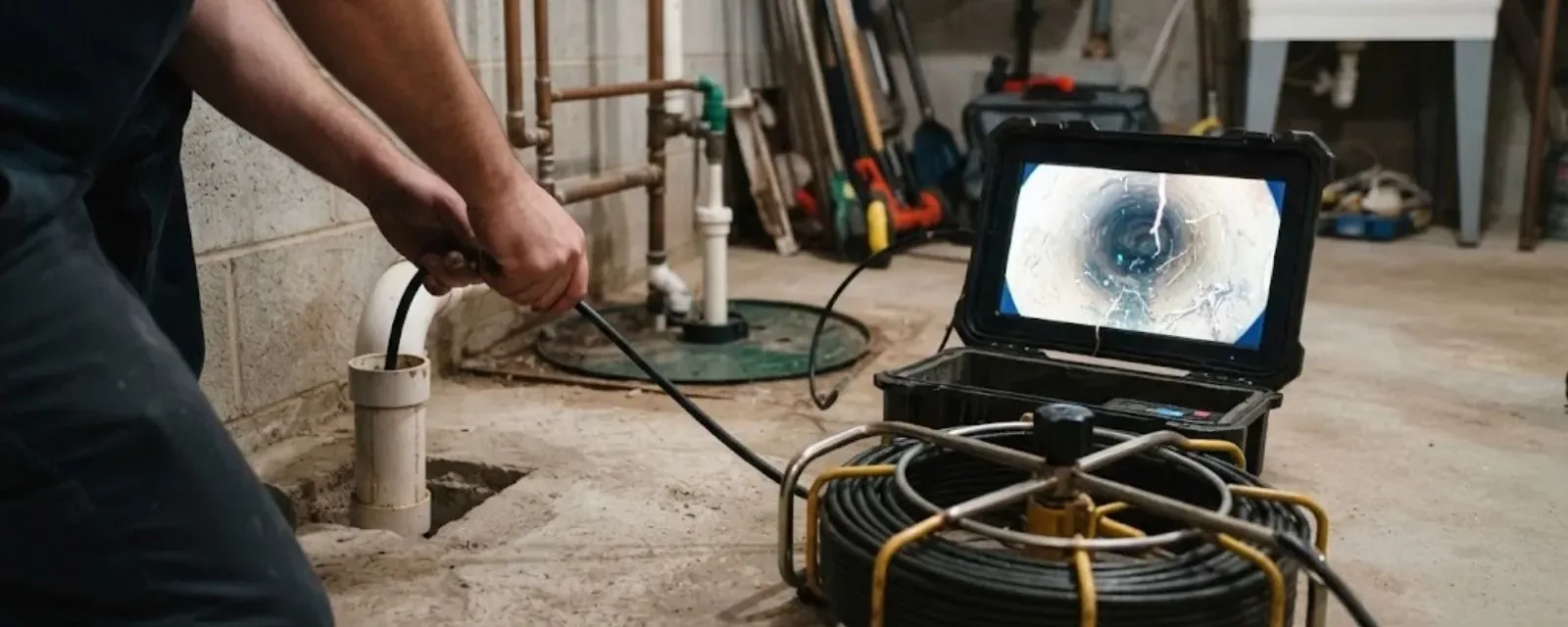
A sewer camera inspection sends a small waterproof camera down your private sewer line while a plumber watches a screen. It finds roots, cracks, sagging sections, grease buildup and collapsed pipe, and it shows how far down the line each problem sits. You need one when drains keep clogging, before you buy a house, or before anyone digs in your yard.
The camera does not fix anything. It replaces guessing with a picture, so the repair that follows is aimed at the actual defect instead of the nearest symptom.
What the camera can show you
The camera enters through a cleanout or a pulled toilet and travels toward the street. The plumber sees the pipe wall, the joints and anything sitting in the bottom of the line.
Common findings include:
- Roots entering at a joint or growing as a mat inside the pipe.
- Cracked or broken sections and joints that have slipped out of line.
- A belly, which is a low spot that holds water and waste.
- Grease, scale or debris coating the pipe wall.
- A crushed or collapsed section where the camera cannot pass.
- Changes in pipe material or direction along the run.
A camera shows condition, not a final repair price. The plumber reads the footage, tells you which findings are serious and which are cosmetic, and explains the options.
Signs it is time to look inside
One clog is an event. The same clog returning every few months is a pattern, and a pattern usually has a cause that cabling alone will not remove.
These are the situations where a camera earns its visit:
- The main line backs up more than once after being cleared.
- Several fixtures gurgle or drain slowly at the same time.
- A sewer smell shows up in the yard or near a floor drain.
- You are under contract on a house with unknown plumbing history.
- You plan a patio, new trees or a trench near the line.
If sewage is already coming up in a tub or floor drain, treat that as an urgent repair call first. Our sewer line repair team handles that situation, and the camera can follow once the line is open.
Your lateral versus the city main
The sewer system has two parts. The main runs under the street and belongs to the city. The lateral is the private pipe that carries waste from your house out to that main.
Which stretch is yours depends on where the city's responsibility ends at your address, so ask before you assume. A camera run through your lateral also shows whether the trouble sits on your side or points toward the main, and that footage is useful when you call the city.
Before you call anyone to dig
Stop and think about these first steps.
- Do not pour chemical drain cleaners into a line that is already backing up. They sit in the pipe and can burn skin when a plumber opens it.
- Locate the cleanout and keep it clear so access is quick.
- Call the Dig Line before any excavation. A camera can tell you where the line is and roughly how deep, but marking utilities is a separate step.
- If sewage is rising in the house, stop running water and call right away.
What happens during a visit
A camera visit is short and mostly about access.
Describe the problem
Tell dispatch about the backups, smells or purchase so the plumber arrives with the right equipment.
Find access
The plumber locates the cleanout or pulls a fixture to reach the line.
Run the camera
The camera travels the pipe while the plumber notes problem spots and distances.
Review the footage
You see what the plumber saw and hear what it means for repair or cleaning.
If the line is packed with debris, it may need clearing before the camera can pass. That is normal, and sewer line cleaning handles it. You are told about any extra step before it begins.
Camera inspection compared with other approaches
| Approach | What you learn | What it misses |
|---|---|---|
| Camera inspection | The real condition of the pipe from the inside | Anything beyond a blockage the camera cannot pass |
| Cabling the line | Whether a clog can be cleared | Why the clog keeps coming back |
| Waiting for symptoms | Nothing until a backup happens | A slow failure that is cheaper to address early |
| Digging blind | Possibly the break | The exact spot, which means a bigger trench |
Buying a house and the sewer line
A home inspector normally looks at fixtures and visible pipes, not the buried line. If you are under contract, a camera look at the lateral can show whether the seller is handing you a root problem or a failing section.
There are limits. The camera sees only the part of the line it reaches, and any finding is something to bring to your agent or the seller. Timelines for inspection periods vary, so ask early.
Want the line checked?
Call (208) 679-8357 and tell dispatch what you are seeing so a camera visit can be planned.
What Kuna's setup means for your sewer line
Sewer mains in Kuna are run by the City of Kuna Wastewater Division, along with the lift stations and treatment facilities. Your lateral connects to that system, so a camera run helps you see whether a backup starts in your pipe or farther along.
If sewage is backing up and you suspect the city main, the City of Kuna lists a sewer emergency line at (208) 573-1511. Call it for the main, and call a plumber for anything inside your property line.
Anyone digging near buried lines should call Dig Line at (208) 342-1585 first. That call protects the pipe you are trying to inspect.
The 2017 Idaho State Plumbing Code, based on the 2015 UPC, sets the slope and joint expectations a camera inspection is compared against.
Source: City of Kuna utilities page and City of Kuna Water Irrigation page
Questions people ask about sewer cameras
No. The camera is a small head on a flexible cable made to pass through drain lines. A badly collapsed section may stop it, and the plumber will tell you if that happens.
Backups in one house usually point to the lateral, while several neighbors reporting trouble can point to the main. A camera helps by showing the condition of your own pipe. If several homes are affected, report it to the city.
It finds clogs, roots and breaks that are visible inside the pipe. A leak is harder to see because water may escape at a joint, so the plumber looks for stains, gaps and offsets.
Plumbing permits in Kuna come from the Kuna Building Department. Sewer line work is listed on the City's plumbing permit application, so call (208) 922-5546 before you plan a repair.
Kuna grew from 15,210 people in 2010 to 24,011 in the 2020 census, so homes of very different ages share the same system. Pipe age and material still vary house to house, which is why a camera look beats assuming.
Serving Kuna and nearby towns
Our plumbers serve Kuna and travel for sewer camera visits in neighboring areas, including the Nampa plumber service area. The full Kuna service area page lists the other towns we cover.