
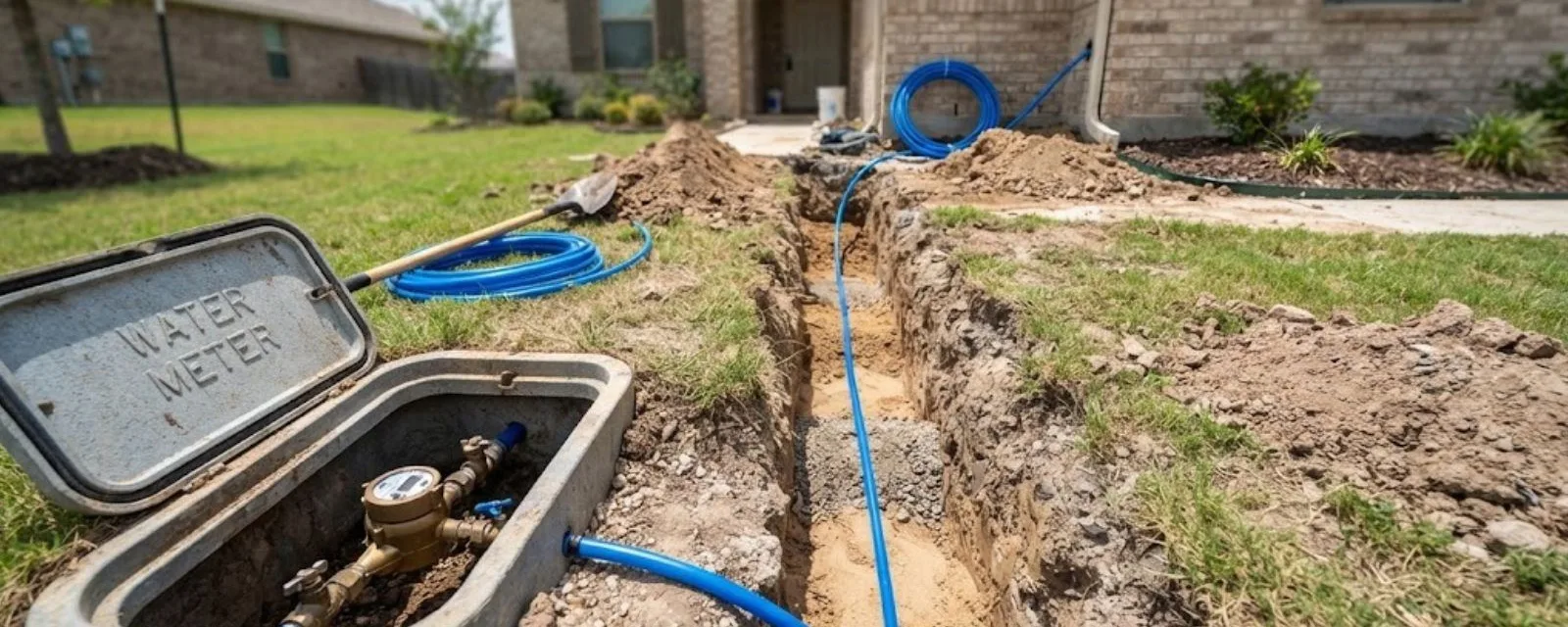
If your water meter keeps moving when every fixture and appliance is off, you have a leak somewhere between the meter and your fixtures. The fastest way to narrow it down is a meter dial check, a toilet dye test, and a look at the yard and outdoor spigots. Most high bills trace back to a running toilet, a dripping valve or an underground line, and each shows up differently in these tests.
Do the tests in order, write down what you see and stop if water is flooding the house. In that case, shut off the main valve first and call right away.
Step one: the meter dial test
Turn off every fixture, appliance, ice maker and irrigation timer. Make sure no one is running water, and do not flush anything during the test.
Open the meter box and find the low-flow indicator, which is a small triangle or dial that spins at the slightest flow. Note the reading, wait 15 to 30 minutes with all water off, then check again. If the indicator moved or the numbers advanced, water is leaking somewhere.
Step two: separate house from yard
Find the main shutoff valve at your house, close it, and look at the meter again. This splits the problem into two zones.
- Meter stops moving: the leak is inside the house, past the shutoff.
- Meter keeps moving: the leak is between the meter and the shutoff valve, usually in the buried service line.
Reopen the main afterward and note the result. This one test tells a plumber where to start, which saves time and cost.
Safe steps while you test
Take these precautions.
- Do not dig in the yard before calling Dig Line for utility marking.
- Do not ignore water pooling near the meter or foundation, because it can undermine soil over time.
- If water is coming up through a floor or wall, shut off the main and call right away.
- Wear gloves and use a flashlight in the meter box, since small animals sometimes nest there.
Step three: the toilet dye test
Toilets are the most common hidden leak because the water slips silently from the tank into the bowl. A dye test takes ten minutes.
Remove the tank lid, drop in a few drops of food coloring and wait without flushing. If color appears in the bowl, the flapper or fill valve is leaking. A toilet that runs on its own, hisses or refills now and then is a good suspect even before the dye test.
A worn flapper is a simple part, but if the toilet leaks at the base or the fix does not hold, toilet repair can handle it properly.
Step four: check the usual suspects
Look past the toilets before you assume the worst. Walk through the house and the yard with this list.
- Dripping faucets, shower valves and tub spouts.
- Water heater base, relief valve line and supply connections.
- Washer hoses, dishwasher supply and refrigerator ice maker line.
- Outdoor spigots, hose bibs and any sprinkler zone that runs after the timer should be off.
- Softener or filter that cycles continuously.
A single drip adds up. Fix what you find, then repeat the meter test to see if the movement stops.
Reading what the meter tells you
| What you see | What it often means | Next move |
|---|---|---|
| Meter moves, shutoff closed | Leak in buried service line or at the meter | Call a plumber, mark the area, avoid digging |
| Meter stops with shutoff closed | Leak inside the house | Dye test toilets, check fixtures, appliances |
| Color in toilet bowl | Flapper or fill valve leaking | Replace parts or call for repair |
| Meter slow but steady | Small drip or seeping valve | Check faucets, heater, irrigation valves |
| No test shows a source | Hidden leak in a wall, slab or line | Leak-finding visit with proper equipment |
Meter still moving?
Call (208) 679-8357 and tell dispatch what the meter did during your tests.
Write it down before you call
A short record makes the phone call faster and the visit more useful. Note the meter reading before and after each test, how long you waited and which fixtures you checked.
Also keep a copy of the bill that looked wrong and the previous few. A plumber and the city can both compare the numbers against your normal use. If you have recently run sprinklers, filled a pool or had guests, mention it so those causes can be ruled out.
When a plumber needs to find it
If the tests show water is leaking but you cannot see where, a plumber uses listening gear and pressure tests to locate the leak without tearing out the house. Underground leaks in the yard are usually found the same way, and then repaired with a plan to limit digging.
A leak in the buried line from the meter to the house is repaired by water line repair. Location comes first, repair second, and the two are priced separately so you know what you are paying for.
City of Kuna water contacts worth saving
The City of Kuna Water Department staff are on call 24/7 for water and irrigation emergencies, and the water emergency number is (208) 573-7676. Use it if water is flooding from the street side of the meter.
For billing and general questions, Kuna Public Works is at (208) 287-1728, and domestic and irrigation water are both handled through City of Kuna Waterworks. Call them to ask how your usage compares with past bills and whether they see anything unusual on their end.
Backflow reports go to the Water Department. If your yard has irrigation, ask whether the system has a backflow device that needs testing.
Repairs found by a leak check are made to the 2017 Idaho State Plumbing Code, based on the 2015 UPC, and a plumber can tell you whether a permit applies.
Source: City of Kuna Water Irrigation page
Questions about meter leaks and high bills
Almost always, yes. Check for a running toilet first, then close the main and see whether the meter still moves. That tells you whether the leak is inside or in the yard.
Yes. A flapper that leaks lets water trickle into the bowl around the clock, and you may not hear it. The dye test finds it.
Call a plumber for anything past the meter on your side. Contact the city if water is surfacing near the street side or you need billing questions answered.
Yes. In Kuna the city irrigation season generally begins mid-to-late April, so a sprinkler valve that sticks open can look like a leak. Check valves and timers before assuming the house is leaking.
Not necessarily. The first step is locating the leak with equipment, which often limits how much digging is needed.
Serving Kuna and nearby towns
Our team serves Kuna and the surrounding area, including the Nampa plumber service area. Check the Kuna service area page to see which neighboring towns we cover.