
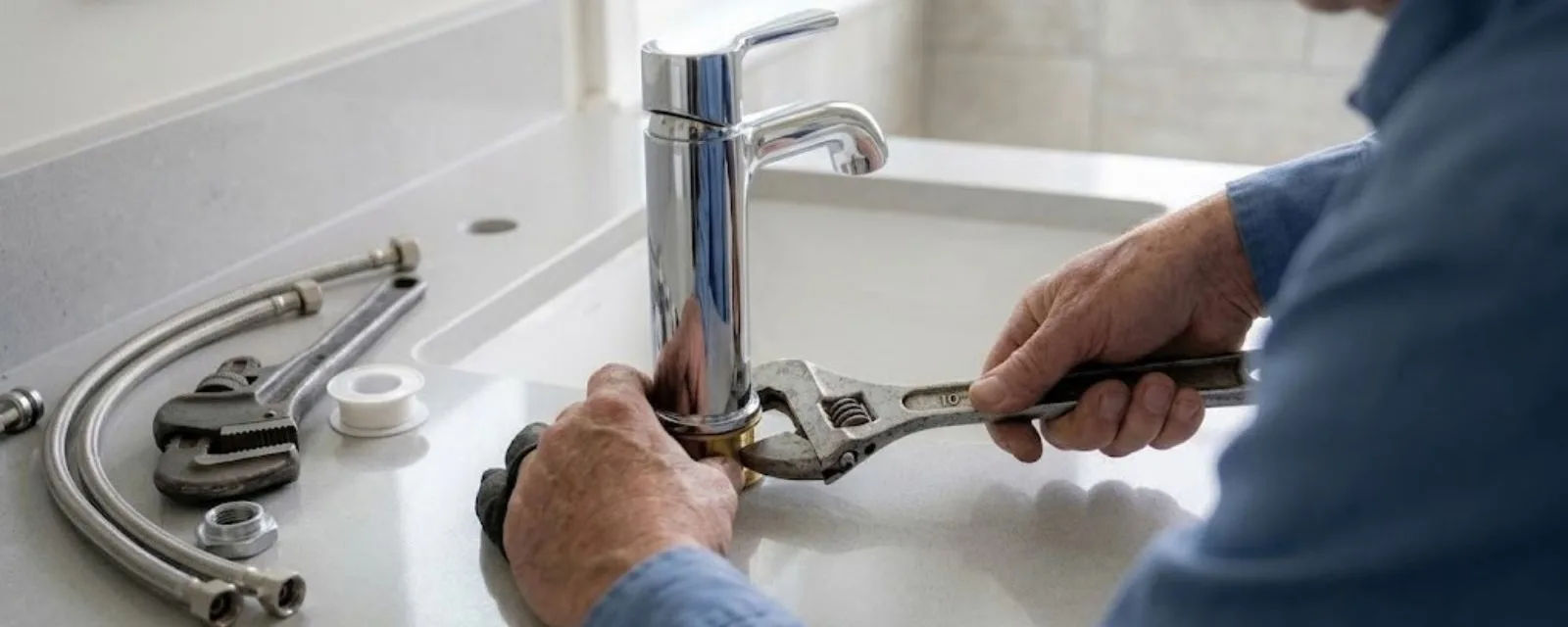
A dripping bathroom faucet usually has a worn cartridge, washer or seat. A faucet with weak flow usually has a clogged aerator, which takes a few minutes to clean. A loose or wobbly handle usually needs a tightened set screw or a new handle connection. Telling these apart saves you from replacing parts that are not broken.
This guide covers each symptom, what to check first, the difference between a cartridge fix and an aerator fix, and the signs that mean it is time to call a plumber. Start by closing the shutoff valves under the sink so you can work without water running.
Start with the shutoffs
Before you touch the faucet, find the two small valves under the sink. Turn each clockwise by hand until it stops. Open the faucet to confirm the water is off and to drain what is left in the line.
If a valve will not turn or starts to weep around its stem, stop. Forcing an old valve can crack it, and then you have a bigger leak than the one you started with. Close the main water valve instead and call a plumber.
Plug the drain with a rag or stopper before you remove any small parts. A tiny screw lost down a drain is a very annoying way to end a repair.
Fixing a drip
A faucet drips because something inside no longer seals when the handle is off. What wears out depends on the faucet type.
- Two-handle faucets use rubber washers or seats that wear down and pit.
- Single-handle faucets use a cartridge with seals that harden or tear.
- Ball and disc styles use springs, seals or ceramic discs that wear or collect scale.
Drips from the spout point to the cartridge, washer or seat. Drips from the base of the faucet or the handle point to worn O-rings or a loose packing nut. Drips from under the sink point to a supply line, a shutoff or the drain, and not the faucet at all.
Check the cabinet floor with a dry paper towel. A faucet that looks dry at the top may be leaking underneath, and the damp wood tells the story.
Cartridge or aerator: which fixes what
These two parts get confused, and they cause very different symptoms. Knowing which is which saves a lot of guesswork.
The aerator is the small screen at the tip of the spout. It mixes air into the stream and catches debris. When it clogs, water flow drops or sprays sideways, but the faucet does not drip.
The cartridge is inside the faucet body behind the handle. It controls flow and temperature. When it wears, you get drips, a handle that is stiff, mixed hot and cold water, or a handle that will not shut off fully.
| Symptom | Most likely part | What to try |
|---|---|---|
| Weak or sideways spray | Aerator | Unscrew, soak in vinegar, rinse, reinstall |
| Drip from spout | Cartridge, washer or seat | Replace the worn part |
| Stiff handle or poor mixing | Cartridge | Replace the cartridge |
| Wobbly handle | Set screw or handle adapter | Tighten, or replace the handle parts |
| Leak around the base | O-ring or packing | Replace the seal |
| Wet cabinet below | Supply line, shutoff or drain | Check each connection |
Low flow: check the aerator first
Low flow from a bathroom faucet is the easiest problem to try yourself. Unscrew the aerator from the tip of the spout, using a cloth to protect the finish if you need pliers. Look for grit, white crust or small flakes.
Soak the aerator in white vinegar for a few hours, then brush it with an old toothbrush and rinse it. Put it back on and test the flow. If the flow is strong again, you are done.
If the low flow stays after a clean aerator, check whether the problem is on one side only. Weak hot water but normal cold water points to a hot supply problem, and weak flow at every fixture in the house points to a pressure or shutoff issue.
Loose or wobbly handles
A loose handle usually has a set screw under a small cap or on the side of the handle. Pry off the cap gently, tighten the screw with the right hex key and test the handle.
If the handle still moves, the problem may be a stripped screw, a worn adapter or a loose nut under the handle. Replacement parts must match the faucet make and model, so take a photo of the faucet and any markings before you shop.
A handle that turns freely without controlling the water means the stem or cartridge connection has broken. Do not keep forcing it. A plumber can replace the cartridge or the stem and restore the control.
Safe steps before any faucet repair
Close the shutoff valves under the sink, or the main water valve if they will not close. Open the faucet to drain the line and plug the drain. Keep a towel and bucket ready, and photograph the faucet before you take it apart so you remember the order of the parts. If water sprays from the wall or you cannot stop it, close the main and call.
When repair is not worth it
Some faucets are not worth rebuilding. If parts are discontinued, the finish is worn through, or the faucet has leaked in more than one place, replacement is usually cleaner. Repeated repairs on an old faucet can cost more than a new one.
A plumber can tell you which makes sense and give you both options. Our faucet repair page describes how we approach drips, stuck valves and replacement. If you want to change the style or add a new fixture, our plumbing installation page covers that work.
Hard water and your bathroom faucet
The City of Kuna 2021 Consumer Confidence Report says all of southern Idaho has hard water because of naturally occurring calcium. The city's water comes from wells, which the report lists as groundwater. For a bathroom faucet, that means white crust on the aerator and around the base is normal, and it is the main reason low flow returns.
The report does not publish a numeric hardness figure, so none is stated here. You can judge your own water by looking at the aerator and the spots on fixtures. If crust returns within a few months, plan on cleaning the aerator on a regular schedule.
Heavy scale also shortens the life of cartridges and seals. If your faucets keep wearing out, mention the crust to the plumber so the repair accounts for it.
Source: City of Kuna CCR
Faucet dripping or leaking now?
Call (208) 679-8357 any hour and describe the faucet, where the water appears and whether the shutoffs close.
Signs it is time to call a plumber
Some faucet problems go beyond a quick DIY fix. Call a plumber if any of these apply.
- A shutoff valve will not close or leaks at the stem.
- Water is leaking inside the cabinet or the wall behind the fixture.
- The faucet is in a wall-mounted or hard-to-reach setup.
- A handle spins freely and the water will not shut off.
- You have replaced a part and the drip came back.
A plumber will check the supply lines, shutoffs and drain as well as the faucet. A leak under the sink is often not the faucet, and fixing the wrong part wastes time.
Beyond Kuna
We take calls from Kuna and from customers reaching us through Nampa and other nearby towns. Our service area page shows where we work, which helps if you are unsure whether your address is covered. Replacement faucets and supply lines should be installed to the 2017 Idaho State Plumbing Code, based on the 2015 UPC, if the work goes beyond a simple repair.
Frequently asked questions
The cartridge, washer or seat inside the faucet no longer seals. The part wears, hardens or collects scale, and water slips past.
Unscrew it from the spout, soak it in white vinegar for a few hours, brush away crust and rinse. Reinstall and test the flow.
Often yes. Tighten the set screw under the cap or on the side. If the handle still moves, the adapter or stem may need a plumber.
The City of Kuna says all of southern Idaho has hard water from calcium. The crust is mineral buildup, and cleaning the aerator regularly keeps flow strong.
Repair makes sense when the problem is one worn part. Replacement makes sense when parts are hard to find, the finish has failed or the faucet leaks in several places.
Yes, if water will not shut off or is soaking the cabinet or wall. Close the shutoffs or the main valve and call.