
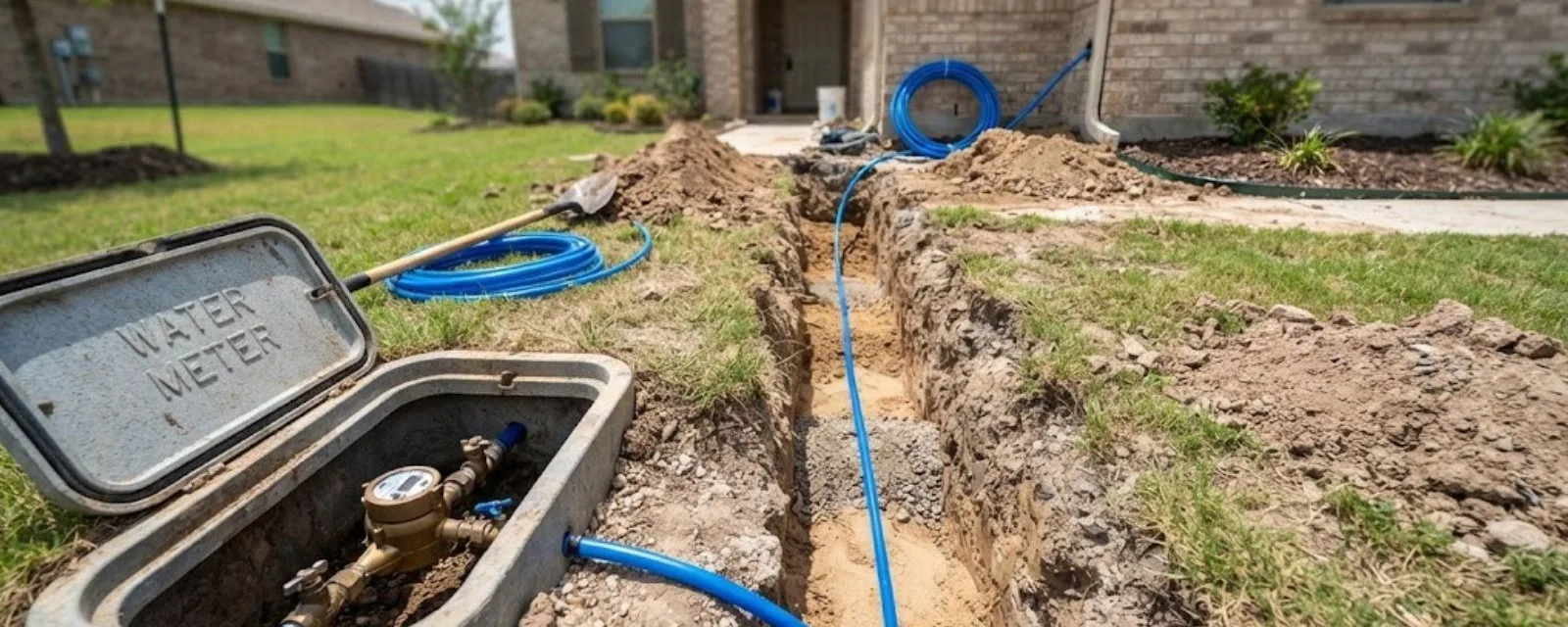
A backflow preventer is a valve assembly on your sprinkler supply line. Its job is to stop water that has sat in your sprinkler pipes, along with whatever it picked up from soil, fertilizer or standing puddles, from flowing backward into the clean water supply. In spring you bring it back into service slowly, look for leaks, and confirm with your water provider whether a test is required for your address.
The rules about who must test, when, and with what equipment come from the water provider and state requirements, not from a blog post. For Kuna, the City of Kuna Water Department is the place to ask. A plumber handles the physical side: inspecting the device, repairing it, or replacing it when it is worn out.
What the device actually does
Water in a sprinkler system is not drinking water the moment it leaves the valve. It sits in buried pipe, it touches soil at every head, and it can pick up fertilizer or pesticide residue. If supply pressure drops, that water can be pulled or pushed backward unless a one-way barrier stops it.
A backflow preventer is that barrier. Some types use spring-loaded check valves, and others use an air opening that closes under pressure. The exact type on your property depends on how the system was built, and the tag or label on the body usually names it.
You do not need to understand the internals to notice trouble. You only need to know what the device looks like when it is healthy: dry, firmly mounted, and quiet when water flows.
A spring startup order that protects the device
Most damage to these assemblies happens in the first few minutes of the season. Opening a valve fast sends a slug of pressure through parts that sat idle all winter, and a worn seal or a hairline crack shows itself right away.
Walk the line first
Look at the assembly and the pipe leading to it. Cracks, a loose mount, or a missing cap are reasons to stop before any water goes in.
Close the downstream valves
Shut the zone valves or the line after the device so the first flow does not rush into the whole yard.
Open the supply slowly
Turn the main sprinkler shutoff a little at a time and listen. A hiss that settles is normal, and a steady spray from the device body is not.
Check for drips and spitting
Watch the assembly for a minute. Water leaking from the relief port or the top of the device is a sign to call.
Run each zone
Open zones one at a time and look at heads, valves and the pipe near the device for wet ground that should be dry.
If a step turns up something odd, close the supply and leave it closed. Running a leaking assembly for the sake of a lawn only makes the repair larger.
What you see and what it may mean
These are common symptoms. None of them is a diagnosis, because the type of device and its age change the answer.
| What you see | What it may mean | What to do |
|---|---|---|
| Water drips from the relief port or the top of the device | A worn seal or debris holding a check open | Shut the supply and call a plumber |
| Cracked body or bonnet | Freeze damage or impact | Stop using the zone, do not tape it |
| Water is on but pressure at heads is weak | Partly closed valve, debris, or a failing part | Open the valve fully, then call if it persists |
| Water supplier notice about a locked valve | A missed test or a required report | Ask the Water Department what it needs |
| Rusty or gritty water from the zones | Debris in the line or an aging fitting | Flush slowly and call if it continues |
Do not paint over, tape or bypass a leaking assembly. A bypass defeats the whole point of the device and can create a real contamination path.
Testing, reports and who to ask
A test is a measured check that the check valves or air opening hold under pressure. It is done with gauge equipment and a written result, so it is not a job to improvise with a garden hose. This page does not state how often a test is due or who qualifies, because that is set outside your plumber's shop.
What we can say is how to get a clear answer. Look for any notice from the water provider, find the device tag, and call the Water Department with your address and what the device is. Ask what documentation they accept and where to send it.
What Kuna's own paperwork tells you
Backflow, irrigation season and permits in Kuna
The City of Kuna sends backflow reports to the Water Department, so a test result or repair record is not something to leave in a drawer. Ask the department how it wants the report delivered before you pay for any testing, so the work is not redone because of a paperwork gap.
The city's irrigation season generally begins in mid-to-late April and depends on when the Boise-Kuna and New York irrigation districts deliver water. That means the practical window to inspect, repair or replace a tired assembly is before the water arrives, not the week your lawn browns.
The January 2025 City of Kuna plumbing permit application lists backflow devices among the covered work. If you are replacing a device and not just cleaning one, call the Kuna Building Department at (208) 922-5546 and ask whether a permit applies.
Source: City of Kuna
When a homeowner should stop and call
Tightening a cap or clearing a clogged head is a fair homeowner job. Replacing a seal kit, rebuilding the assembly, or moving the device is not, because a mistake can leave the device looking fine while it no longer works.
Call a plumber when:
- the device leaks from the relief port or the body after a slow startup
- there is a crack, even a thin one
- the device has been under water, buried or frozen
- the water supplier locked a valve or sent a notice you do not understand
- you want the assembly moved, raised or replaced
Commercial properties often have more than one device, and larger lines make mistakes costlier. If you manage a plaza, a rental or a shop, our commercial plumbing page explains how we handle work at that scale.
Safe steps for a leaking assembly
Close the sprinkler supply valve before the device and leave it closed. Do not stand in line with a spraying port, because pressurized water can sting. Keep children and pets away from the wet area. Do not wrap the leak with tape or sealant, since the device needs to be opened and inspected, not masked.
Once the supply is off, take a photo of the tag and the leak. That helps the plumber bring the right parts on the first trip.
Wet ground near the device
Sometimes the leak is not the device at all. Wet soil near the assembly can come from a cracked pipe, a failed fitting, or a valve box that has filled with water. A quiet leak can run for weeks because the water just soaks into the soil.
If you see soggy ground that does not dry between irrigation cycles, shut the zone off. A leak detection visit can separate a device problem from a buried pipe problem before anyone digs.
Nampa, Meridian and nearby yards
Kuna Express Plumbing serves Kuna and nearby towns, and sprinkler startup trouble looks similar from one yard to the next. If you are on the Nampa side of the valley, the Nampa plumbing page covers what we do there. Water providers differ by city, so always ask the one that supplies your address what it needs.
You can also check the service area page to see where we work. If you are not sure we reach your address, that page answers it. Backflow devices are covered by the 2017 Idaho State Plumbing Code, based on the 2015 UPC, and the Kuna permit application lists backflow devices among its covered work.
Sprinkler device leaking now?
Call (208) 679-8357 and describe what you see at the device. The line is answered 24/7.
Questions people ask about sprinkler backflow
Many systems need one, but the requirement depends on how your system connects to the supply and what the water provider requires. Ask the Water Department for your address. A plumber can look at the connection and tell you what is installed.
A proper test uses gauge equipment and produces a written result. A homeowner can inspect the device and watch for leaks, but a test the water provider accepts is a separate step. Ask the provider who can perform it.
Spitting usually means a worn seal, debris, or a check valve that is not seating. Shut the supply and call a plumber. Running it that way can push more debris through.
Call the provider and ask what is missing, such as a report or a repair. Do not try to force or remove the lock. A plumber can handle any repair, and the provider tells you how to submit the proof.
Start with the City of Kuna Water Department, since it supplies the answer for city service. Bring the device tag details and any notice you received. Do that before you pay anyone for a test.